2/28/11

Arthur Hughes, Sir Galahad


Walker Art Gallery, Liverpool

Date: 1865-1870
Technique: Oil on canvas, 167.5 x 113 cm

Source

Arnold Böcklin, Pan Amongst the Reeds


Oskar Reinhart Foundation, Winterthur

Date: 1856-57
Technique: Oil on canvas

Source

2/26/11

Mikhail Vrubel, Flying Demon


The State Russian Museum, St. Petersburg

Date: 1899
Technique: Oil on canvas,158 x 430.5 cm

The Demon is a central theme of Vrubel's work. The artist returned it throughout his career, embodying the image in painting, drawing and sculpture. The image of the Demon first entered the artist's mind during the Kiev period, when he was sketching murals for the Vladimir Cathedral (1884-1889). As he pondered the challenges of monumental painting, Vrubel studied Byzantine mosaics and frescoes. In a time of a deep crisis in faith and religious searching, thinking about the spiritual ideal, the artist did not find it in the image of Christ, although he did make some attempts. The era of Art Nouveau and Symbolism made beauty an absolute, a higher truth. Vrubel created the image of the "Light" Demon, attempting to deviate from the Christian interpretation of his hero as the personification of darkness, but he did not accept old traditions or contemporary interpretations of European Symbolism. He said: "The Demon is misunderstood; he is confused with the devil… But Demon is Greek for ‘Soul." Having passed a complex path of rethinking literary prototypes (Hamlet and Ophelia, 1884, State Russian Museum; Hamlet and Ophelia, 1888, State Tretyakov Gallery; polyptych on the theme of Goethe's Faust, 1896, State Tretyakov Gallery; Head of the Demon, State Tretyakov Gallery) the artist departed from them.

Mikhail Vrubel, Flying Demon


Date: Unknown
Technique: The paper, black watercolor, bleached

Source

2/25/11

Mikhail Vrubel, Flying Demon


Date: Unknown
Technique: The paper, black watercolor, bleached

Source

Wilhelm Kotarbiński, The Kiss of Medusa


Date: Unknown
Technique: Unknown

Wilhelm Kotarbiński, Dark Star


Date: Unknown
Technique: Unknown

2/24/11

Wilhelm Kotarbiński, The Angels of the Pyramids


Private collection

Date: Unknown
Technique: Watercolor, 32.50 cm x 65.50 cm

Source 1
Source 2

Edward Robert Hughes, Dream Idyll (A Valkyrie)


Private collection

Date: Unknown
Technique: Gouache and pastel on stretched paper, 43 1/4 x 31 1/8 in.

Source 1
Source 2

Alfons Maria Mucha, Pole Star


Private collection

Date: 1902
Technique: Color lithograph, 59 x 23.5 cm

From The Moon and the Stars series

Source 1
Source 2

Alfons Maria Mucha, The Moon


Private collection

Date: 1902
Technique: Color lithograph, 59 x 23.5 cm

From The Moon and the Stars series

Source 1
Source 2

John Charles Dollman, The Ride of the Valkyrs


Date: 1909
Technique: Unknown

From Hélène Adeline Guerber, Myths of the Norsemen from the Eddas and Sagas. This illustration facing page 176.

Source

2/23/11

Odilon Redon, Through the Crack a Death's-Head Was Projected


The Museum of Modern Art, New York

Date: c. 1886
Technique: Charcoal and chalk on paper, 43.2 x 30.5 cm

Source

Odilon Redon, The Masque of the Red Death


The Museum of Modern Art, New York

Date: 1883
Technique: Charcoal and chalk on paper, 43.7 x 35.8 cm

Source

Odilon Redon, Head of Orpheus


The Museum of Modern Art, New York

Date: c. 1881
Technique: Charcoal on colored paper, 44.5 x 53.7 cm

Source

2/22/11

Eugène Roger, Ghouls


Private collection

Date: Unknown
Technique: Oil on canvas, 7 x 9 in.

Source

2/21/11

Evelyn de Morgan, S.O.S.


The De Morgan Centre, London

Date: 1916
Technique: Oil on canvas

In the 1880s with the onset of the Boer War, and later in World War 1 in 1914, De Morgan used her art to express the fears shared by many about the effects and horrors of war. In paintings such as S.O.S. De Morgan combines an anti-war message with her spiritualist beliefs. Here, a lone figure stands on a rocky outcrop in the ocean, beset on all sides by mythological beasts. This can be read as dismay at the encroaching war, and also in terms of De Morgan’s spiritualist belief in the redemptive figure of the female, as a symbol of optimism.

Source 1
Source 2
Source 3

2/15/11

Viktor Mikhailovich Vasnetsov (1848 - 1926)

Viktor Mikhailovich Vasnetsov was a Russian artist who specialized in mythological and historical subjects. He is considered a key figure of the revivalist movement in Russian art.

Viktor Vasnetsov was born in a remote village Lopyal of Vyatka guberniya in 1848. His father Mikhail Vasilievich Vasnetsov, a village priest, was a well-educated 'philosophy-inclined' man interested in natural science, astronomy and painting. His grandfather was an icon painter. Two of his three sons, Viktor and Apollinary, became remarkable painters, the third one becoming a schoolteacher. Recalling his childhood in a letter to Vladimir Stasov, Vasnetsov remarked that he "had lived with peasant children and liked them not as a narodnik but as a friend".

Max Slevogt, Dance of Death (Totentanz)


Museum Georg Schäfer, Schweinfurt

Date: 1896
Technique: Oil on canvas, 102 x 123 cm

Source

2/11/11

Richard Dadd, The Fairy Feller's Master-Stroke


Tate Gallery, London

Date: 1855-64
Technique: Oil on canvas, 540 x 394 mm

Richard Dadd painted this work in the Bethlem Hospital where he was sent after murdering his father and being declared insane. The scene was drawn from his imagination. It shows the ‘fairy-feller’ poised to split a large chestnut which will be used to construct Queen Mab’s new fairy carriage. The style, subject and shifting scale of the painting all contribute to a sense of the fantastic that fits the critic Herbert Read’s idea of an imaginative tradition running through to Surrealism in the early twentieth century.

Source 1
Source 2

Richard Dadd, Come Unto These Yellow Sands


Private collection

Date: 1842
Technique: Oil on canvas, 21.75 x 30.5 in.

Source

John Anster Fitzgerald, The Fairy Bower


Private collection

Date: Unknown
Technique: Oil on canvas, 30.5 x 26 cm

Source

John Anster Fitzgerald, The Woodcutter's Misfortune


Private collection

Date: Unknown
Technique: Oil on canvas, 61 x 30 cm

Source 1
Source 2

John Anster Fitzgerald, Fairy Hordes Attacking A Bat


Private collection

Date: Unknown
Technique: Watercolour with gouache, 54 x 35.5 cm

Source 1
Source 2

2/9/11

Max Klinger, The Isle of the Dead (after Arnold Böcklin)


The Art Institute of Chicago

Date: 1890
Technique: Etching and aquatint in black ink on ivory wove paper, laid down on ivory wove plate paper (chine collé), 418 x 694 mm

Source

Max Klinger, The Castle by the Sea (after Arnold Böcklin)


The Art Institute of Chicago

Date: 1887
Technique: Etching and aquatint on ivory wove paper, laid down on ivory wove paper, 760 x 557 mm

Source

2/8/11

George Frederic Watts and assistants, The Court of Death


Tate Gallery, London

Date: c. 1870-1902
Technique: Oil on canvas, 4242 x 2743 mm

This painting was intended for the chapel of a paupers’ cemetery. Death is shown as an enthroned angel, holding a baby which shows, according to Watts, that ‘even the germ of life is in the lap of Death’. Flanking Death are allegorical figures of Silence and Mystery, guarding what lies beyond the veil: sunrise and the star of hope.

In the foreground a warrior surrenders his sword and a duke his coronet, showing that worldly status offers no protection. But Death also offers refuge: a man with crutches finds relief from pain, while a pale, sick woman rests her head.

Source

George Frederic Watts, Jonah


Tate Gallery, London

Date: 1894
Technique: Oil on canvas, 1555 x 914 mm

In this dramatic image Watts presents the gaunt Old Testament prophet Jonah warning the Ninevites to repent of their behaviour. The sins he denounces are shown in three parallel friezes, based on sculptures from the walls of Nebuchadnezzar’s palace: gambling, drunkenness, and greed – indicated by a group of figures crawling up to the money bags scattered on the floor.

Source 1

Source 2

George Frederic Watts, Mammon: Dedicated to his Worshippers


Tate Gallery, London

Date: 1884-85
Technique: Oil on canvas 182.9 x 106 cm

Watts painted Mammon as an entirely new subject for his own collection. It sums up many of his concerns at this stage in his career. With forthright clarity, its indisputable message cannot be denied and is enhanced by the nearly life-size scale of the work. The word 'Mammon', in origin Aramaic for riches, can be defined as wealth elevated to the position of an idol, amounting to an evil influence. In medieval times, the word was used as the proper name for the demon of covetousness. Throughout Watts's own writings, one finds many of the ideas which fed into Mammon. In 1880, Watts wrote in his article 'The Present Conditions of Art' (see p.72) about contemporary life: 'Modern habits of investigation have sapped unquestioning faith, and have not supplied anything more consoling. Material prosperity has become our real god, but we are surprised to find that the worship of this visible deity does not make us happy' (reprinted in Watts 1912, III, p.166). Mammon follows a few years after these remarks as a visualisation of Watts's firmly held belief in the evil of accruing money for its own sake.

Mammon is enthroned, like an ancient king, but further consideration reveals his grotesque physical appearance and his heartless cruelty. He crushes a youth under one foot; while a beautiful girl collapses under his massive fist. These figures, clearly emblematic of youth, innocence and beauty, appear lifeless and inert. Mammon, colossal in scale by comparison, sits in full glory with his 'gorgeous but ill-fitting golden draperies, which fall awkwardly about his coarse limbs' (Spielmann 1886, p.21). Moneybags fill his ample lap. In the oil study (Watts Gallery, Compton), Mammon is also characterised by his bandaged, gouty foot, another sign of his indulgence in luxuries, and further transforming him into a malformed monster.

Watts consciously manipulated art-historical conventions to heighten the impact of the picture. The format, with a nearly full-scale figure seated against a curtained background, calls to mind the tradition of the grand manner portrait, chiefly associated with masters of this genre in the late eighteenth century. In the case of Mammon, expectations are confounded: instead of an established worthy or famous beauty, the artist instead presents an object of disgust and horror seated on a throne decorated with skulls. The glimpse behind the curtained background reveals not a peaceful landscape garden or estate, but a view of fire and destruction.

Mammon's headgear is a clear reference to the 'Midas-eared Mammonism' excoriated by Carlyle in Past and Present (see p.29). It consists of a crown circled with upended gold coins, with ass's ears affixed to each side. It carries several iconographic meanings of its own, usually referring to ignorance and stupidity. Ovid's Metamorphoses told the story of King Midas, whose touch turned everything to gold, to whom Apollo gave ass's ears because he did not respond the music of the lyre. A link with Midas underlined Watts's message about the evils of wealth. There was also a saying current in the nineteenth century, 'King Death hath asses' ears', from Death's Jest Book of 1850 by Thomas Lovell Beddoes, which also relates to and enhances the meaning of Mammon.

The best-known reference to Mammon in literature appeared in Spenser's Faerie Queene, book II, canto 7, when Sir Guyon discovers the cave of Mammon, the treasure-house, or 'house of Richesse', of the god of wealth. Watts had frequently turned to Spenser's work, as, for example, in the various versions of Britomart. Spenser's lines characterise Mammon as bearing long claw-like nails and as tanned by soot from the blacksmith's forge, a detail one can link with the smoke in the Watts's painting. In his lap, Mammon carried a mass of gold coins and around him were great heaps of gold with which he tried to tempt the good knight.

The subtitle of the painting - Dedicated to his Worshippers - suggests other meanings for the work. Mrs Watts recorded that the artist would often preach against Mammon-worship, once saying 'Holy Mammon - Divine Respectability - Sacred Dividend'. He told the artist Briton Rivière, a good friend, that 'he was going to propose to one of our sculptors to make a statue of Mammon, that it might be set up in Hyde Park, where he hoped his worshippers would be at least honest enough to bow the knee publicly to him' (Watts 1912, II, p.149). As a sculptor himself, Watts may well have intended carrying out this idea; indeed the subtitle to the painting is like an inscription on a monument. A public monument would have had the advantage of being seen by an audience even wider than those attending fine art exhibitions.

In 1889, Mammon appeared as part of a group of nine works sent to the Universal Exhibition and of all of these works, including Hope, The Judgement of Paris and Love and Life, Mammon presented the most disturbing vision. Recalling that Sizeranne identified the exhibition of 1889 as a defining moment when the Symbolists seized upon the works of Watts and Burne-Jones (see pp.76-7), it must surely have been the imagery of cruelty, destruction and evil in Mammon that appealed to the more extreme members of French decadent circles.

Barbara Bryant

Source

2/7/11

Francisco de Goya, Witches' Sabbath - The Great He-Goat (El aquelarre, o El Gran Cabrón)


Museo del Prado, Madrid

Date: 1820 - 1823
Technique: Mixed technique on wall, 140,5  x 435,7 cm

All of the witches are facing a demon in the form of a male goat that presides over the ceremony, ''aided'' by a ''secretary'', to his right. At the other end there is a young woman, almost a girl, seated on a chair, waiting for the initiation to begin.
The group of witches that are the focus of the scene are not moving about, but neither are they motionless. Goya's brushwork, each stroke, and the overall composition give the group considerable dynamism, as if they were worked up by some sort of ectasy. The faces are deformed, figures are bent, and some of them seem frightened.

In this work Goya returns to themes that had interested him in the final years of the eighteenth century, in his drawings, prints, and paintings. In this series the artist eliminates all sense of comedy, even the critical approach he had used in earlier years. He does not criticize witchcraft, neither does he ridicule it; he limits himself to presenting the world of darkness. (Valeriano Bozal, Goya-Black Paintings)

Source

Gaetano Previati, The Dance of the Hours (Danza delle ore)


La Fondazione Cariplo, Milano

Date: c. 1899
Technique: Oil and tempera on canvas, 134 x 200 cm

This work aroused little enthusiasm among critics when it was shown in Venice at the 3rd Esposizione Internazionale d’Arte della Città di Venezia in 1899 as regards both its subject, the symbolic meaning of which escaped them, and the application of paint in separate colours. The art dealer Alberto Grubicy, who was responsible together with his brother Vittore for the spread of Divisionism in Italy, maintained his faith in the painting’s merit and continued to show it in exhibitions, including one in Munich in 1901 and a solo show in Venice in the same year. Having entered the collection of Carlo Sacchi in 1919 to hang in Milan alongside other masterpieces by the artist as well as Divisionist paintings by Vittore Grubicy, Emilio Longoni and Giuseppe Pellizza, it was auctioned together with the other works in separate lots in 1927. Cariplo bought it for the sum of 170,000 lire, having agreed with the collector that a sizeable proportion of the amount would be donated to two clinics for the treatment of tuberculosis, namely the Villa dei Pini in Urago d’Oglio and the Opera Leone XIII in Chiavari.

Previati reinterpreted the subject, an iconographic theme in existence since the decorative painting of the Renaissance era, drawing inspiration also in the title from the then celebrated ballet of the same name in the third act of La Gioconda, composed by Amilcare Ponchielli to a libretto by Arrigo Boito. First performed in Milan in 1876, the opera was based in turn on a play by Victor Hugo.

The painting shows twelve female figures representing the hours and mythologically personifying the seasons. Set in cosmic space flooded with light between the Sun and the Earth, they dance in a circle that alludes to the constant and never-ending succession of day and night. The dance thus becomes an allegory of time as the law that governs life. As presented in Divisionist painting, it also suggests the idea of a universe perceived as pure light and pure music, a recurrent concept in Symbolism and especially in the poetry of Baudelaire and Mallarmé. This was no new subject for Divisionist painters, having already been depicted in 1888 by Giovanni Segantini in The Morning Hours (Milan, private collection). Previati was also to return to it in later years in works such as the triptych The Day (Milan, Camera di Commercio, dell’Industria e dell’Artigianato).

Source 1
Source 2
Source 3

Gaetano Previati, Cronos


Location unknown

Date: Unknown
Technique: Unknown

Source

2/4/11

Charles Altamont Doyle, Meditation, Self Portrait


Victoria and Albert Museum, London

Date: 1885-93
Technique: Watercolour, 17.8 x 26.5 cm

This watercolour comes from one of the sketchbooks used by the artist during his stay in the Royal Montrose Lunatic Asylum in Scotland. His son, the writer Sir Arthur Conan Doyle, organised an exhibition of the artist's work in London in 1924.

Source 1
Source 2

2/3/11

Charles Altamont Doyle, Saint Giles - His Bells


St. Giles' Cathedral, Edinburgh

Date: Unknown
Technique: Watercolour and ink drawing, 95.6 x 63.5 cm

Charles Altamont Doyle described the spirits he painted in the night sky above St Giles' Cathedral in Edinburgh as 'personified memories recalled by the Bells as they ring a merry Midnight'. His phantasmagoric watercolour St Giles shows a stream of ghosts haunting the city, and includes heroes and villains, celebrities and members of the mob: Montrose is being driven to his execution; Prince Charles is escorted by the Clans; George IV enters the city in a carriage. With these figures are representatives of the Auld Town Guard, Fishwives of the City, and the 4th Light Infantry, seen departing for the Crimean War in 1854. Few watercolours reveal with such surreal clarity the painter's disturbed or joyful visions of the spirit world.

Source 1
Source 2
Source 3

Francisco de Goya, Two Old People Eating (Dos viejos comiendo)


Museo del Prado, Madrid

Date: 1821 - 1823
Technique: Mixed technique on wall, 49,3 cm x 83,4 cm

Only one of the old people, the one holding a spoon, seems to be eating and the figure seems more like that of an elderly woman than a man. The figure gesturing alongside looks like an eyeless corpse, as if it were the image of Death itself...
These figures are part of the repertory of witches and old hags that Goya depicted in his drawings, his prints, and his paintings. They are similar to those we find in other works of the series of Black Paintings. They are not so much a representation of the world as an allegory of it. The world they people is a world of darkness and expressive dramatic effects, and this may be understood as emblematic of the whole series of images that Goya painted in this room...
In spite of its small size - it is the smallest of all the Black Paintings - Two People Eating makes a lasting impression on us: the cadaverous faces are not devoid of ironic gesture, or a sarcastic grimace, and in this way the artist ''humanizes'' what would otherwise have been only simple death masks. (Valeriano Bozal, Goya-Black Paintings)

Source

Francisco de Goya, Two Old Men (Dos frailes)


Museo del Prado, Madrid

Date: 1820 - 1823
Technique: Mixed technique on wall, 142,5 cm x 65,6 cm

Companion to Leocadia, situated on the other side of the entrance, here Goya has painted a bearded old man leaning on a large staff and wrapped in a cape, who is listening to what a deformed figure is whispering in his ear. (Valeriano Bozal, Goya-Black Paintings)

Source

Grant Wood, American Gothic


The Art Institute of Chicago

Date: 1930
Technique: Oil on beaver board, 78 x 65.3 cm

Grant Wood adopted the precise realism of 15th-century northern European artists, but his native Iowa provided the artist with his subject matter. American Gothic depicts a farmer and his spinster daughter posing before their house, whose gabled window and tracery, in the American gothic style, inspired the painting's title. In fact, the models were the painter's sister and their dentist. Wood was accused of creating in this work a satire on the intolerance and rigidity that the insular nature of rural life can produce; he denied the accusation. American Gothic is an image that epitomizes the Puritan ethic and virtues that he believed dignified the Midwestern character.

Source

2/2/11

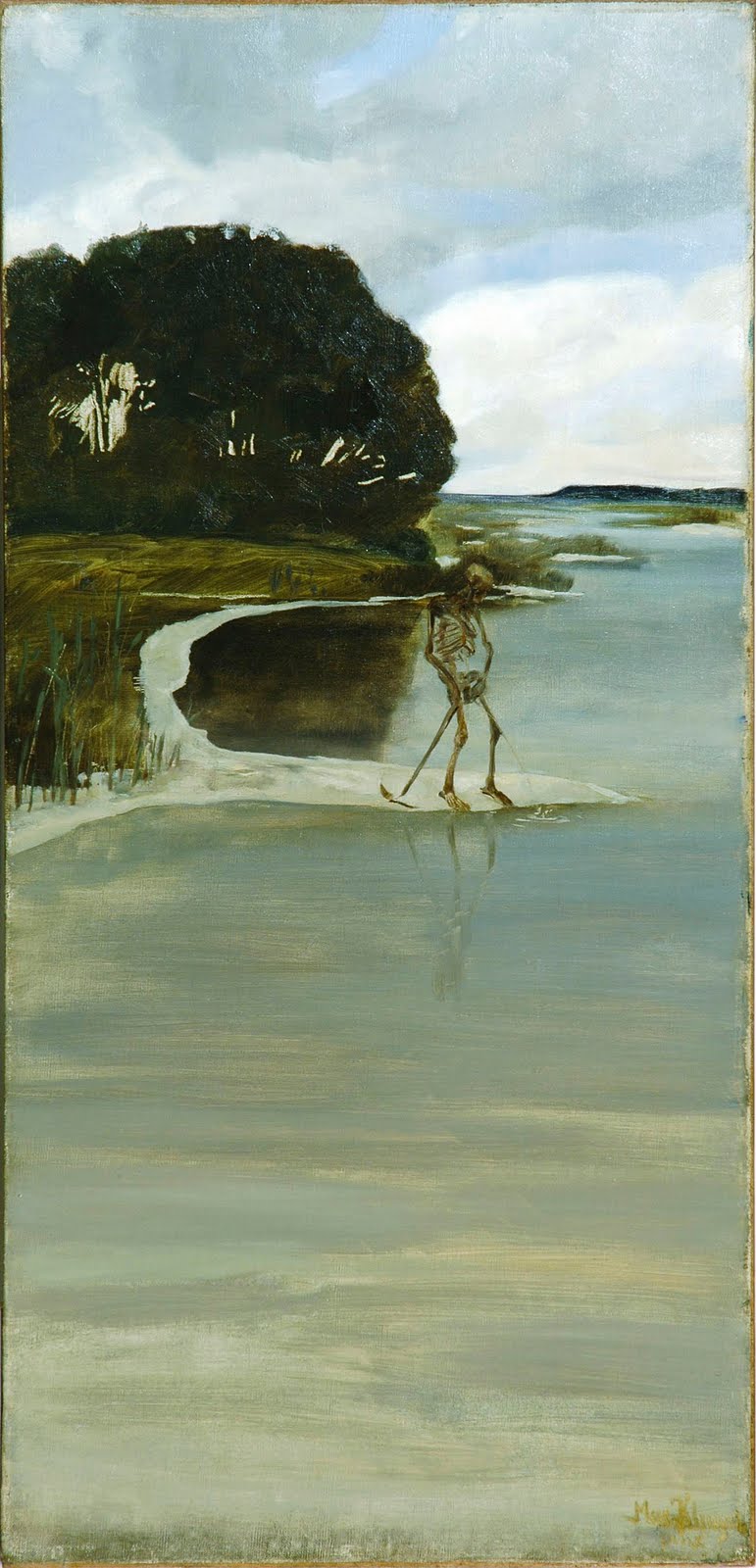
Max Klinger, Peeing Death (Der pinkelden Tod)


Museum der bildenden Künste, Leipzig

Date: 1880
Technique: Oil on canvas, 95 x 45 cm

Source

Francisco de Goya, A Manola: Leocadia Zorrilla (Una manola: Leocadia Zorrilla)


Museo del Prado, Madrid

Date: 1820 - 1823
Technique: Mixed technique on wall, 145,7 cm x 129,4 cm

A feminine figure is seen leaning against a funerary mound. In the quinta it was placed opposite Saturn, which it seems to contemplate, as well as Judith and Holofernes. The attitude of the manola corresponds to the established mode of representing Melancholy. Much has been written about the personality of this woman, who is thought to be Leocadia Zorrilla, wife of Isidoro Weiss, whose relationship with the artist is still lost in the shadows. (Valeriano Bozal, Goya-Black paintings)

Source

Francisco de Goya, Judith and Holofernes (Judit y Holofernes)


Museo del Prado, Madrid

Date: 1820 - 1823
Technique: Mixed technique on wall, 146 cm x 84 cm

This painting forms a pair with Saturn, even though it inverts the terms: here it is a woman who kills a man. It represents a biblical scene (Judith 13) in which Judith cuts off the head of Holofernes. (Valeriano Bozal, Goya-Black paintings)

Source

2/1/11

August Brömse, The Lost Paradise


National Gallery, Prague

Date: 1902
Technique: Aquatint, 29.7 x 40 cm

From the series The Girl and Death

Source

August Brömse, I'm Coming


National Gallery, Prague

Date: 1902
Technique: Aquatint, 38.9 x 49.5 cm

From the series The Girl and Death

Source

August Brömse, Dance


National Gallery, Prague

Date: 1902
Technique: Aquatint, 18 x 25.3 cm

From the series The Girl and Death

Source

August Brömse, An Old Song


National Gallery, Prague

Date: 1902
Technique: Aquatint, 38 x 49.5 cm

From the series The Girl and Death

Source

August Brömse, Life Escaping


National Gallery, Prague

Date: 1902
Technique: Aquatint, 18 x 25.6 cm

From the series The Girl and Death

Source

August Brömse, In the Park


National Gallery, Prague

Date: 1902
Technique: Aquatint, 49.5 x 39 cm

From the series The Girl and Death

"The Girl and Death" is a modern variant of the Dance of Death. Death (a skeleton) plays a fantastic song on the violin; the girl listens in fascination and dances a wild dance — death accompanies her life's pilgrimage. Life becomes endless suffering for the girl, cursed by the deity; her love is fatefully led from the start by tragic steps. As a symbol of the first fruits of sin the girl, in some sort of hypnotic trance, flies through space on a great snake which — in some prints of the series — holds an apple in its mouth. The concept of the landscape evokes a sense of unreality and timelessness. One of the last prints brings the whole story up to date. The girl lies prostrate on a window-sill; the anonymous roof tops of the modern city appear in the background." — Otto M. Urban, p. 197

Source

August Brömse, By the Window


National Gallery, Prague

Date: 1902
Technique: Aquatint, 39.8 x 29.3 cm

From the series The Girl and Death

August Brömse, who was born in Frantiskovy Làzne and attended the Akademischen Hochschule fur bildende Kunste in Berlin, was one of many Czech artists influenced by contemporary German art and culture, especially by the graphic work of Max Klinger. According to Otto M. Urban,

The series The Girl and-Death, which originated in Berlin in 1901-1902, echoes the relationship of August Bromse with the concert singer Eisa Schünemann (they had known each other since 1902 but did not marry until 1910 when he was already living in Prague and heading the print studio at the Prague Academy), as does the later Nietzsche series "The Whole Being is Burning Sorrow" (1903, awarded a prize 1905 at the Paris exhibition). "The Girl and Death" is a modern variant of the Dance of Death.

Source

Andor Novák, Femme Fatale


Private collection

Date: Unknown
Technique: Oil on canvas, 131 x 100 cm

Source 1

Source 2