Private collection
Date: c. 1873
Technique: Watercolour, bodycolour and gum arabic on paper, extended along the lower edge, 96.5 x 152.4 cm
Source
National Trust, Wightwick Manor
Date: 1894
Technique: Oil on canvas, 101 x 154 cm
Source
Showing posts with label Edward Burne-Jones (1833-1898). Show all posts
5/26/19
6/30/15
Edward Burne-Jones, The Last Sleep of Arthur in Avalon
Date: 1881–98
Technique: Oil on canvas, 277.5 x 635 cm
6/26/15
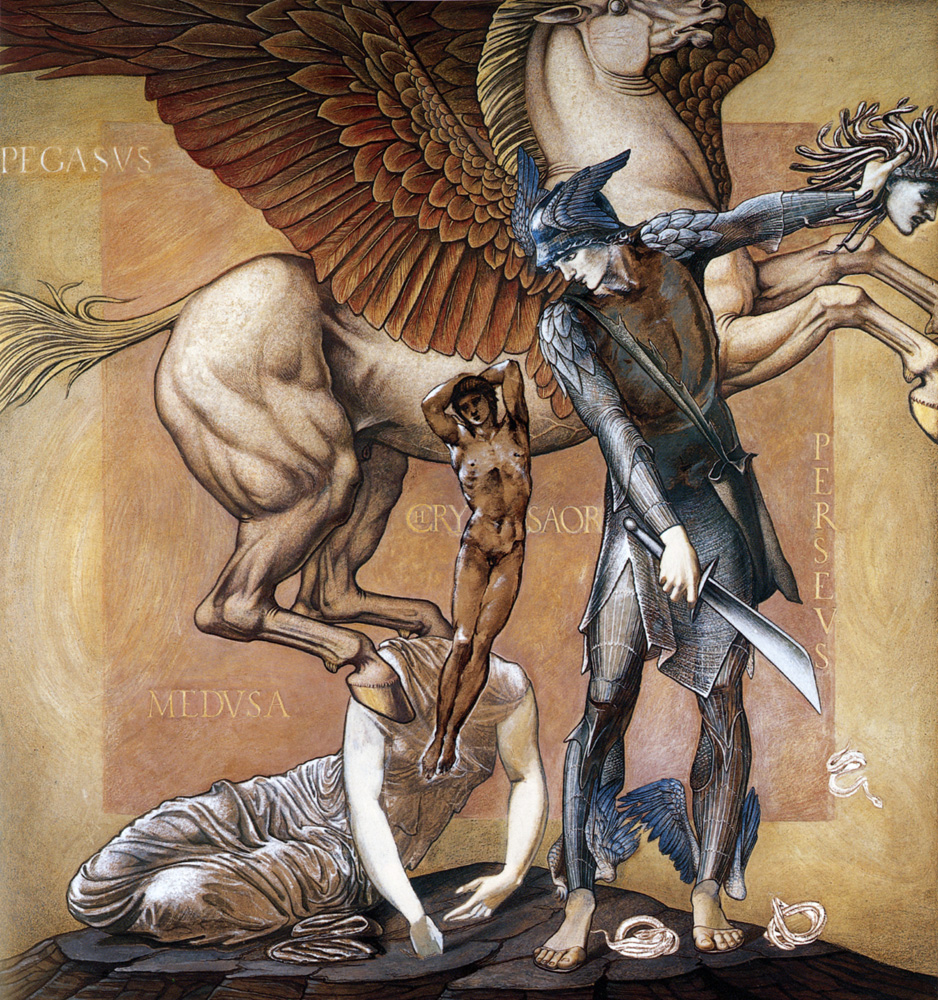
Edward Burne-Jones, The Death of Medusa I
Date: 1882
Technique: Bodycolour, 124.5 x 116.9 cm
From the Perseus series.
Edward Burne-Jones, The Death of Medusa II
Date: 1881-82
Technique: Bodycolour, 152.5 x 136.5 cm
From the Perseus series.
9/2/11
Edward Burne-Jones, The Wheel of Fortune
Musée d'Orsay, Paris
Date: 1883
Technique: Oil on canvas, 200 x 100 cm
"My wheel of Fortune is a true-to-life image; it comes to fetch each of us in turn, then it crushes us," was Burne-Jones' heartfelt or disillusioned comment. The work is a perfect example of his taste for classical myths and medieval legends, which mingle uneasy sensuality and a feeling of disquiet, which make his symbolism particularly bitter. This Fortune is one of his most powerful compositions. The wheel spans the whole painting from top to bottom, turning in a relentless rise and fall, while the implacable, gigantic goddess forms a pendant for the powerless mortals: a slave, a king and a poet.
The canvas is entirely covered with the bodies and the wheel, the palette ranges from steel grey to brown, accentuating the suffocating mood and the sense of hopeless fatality. The female figure is draped in an antique toga falling in Botticelli-like folds drawn with remarkable skill; the nudes are inspired by Michelangelo's figures for the Sistine Chapel.
The painting was exhibited in London in 1883 and immediately acclaimed as a capital work in the Pre-Raphaelite movement.
Source 1
Source 2
6/17/11
Edward Burne-Jones, The Doom Fulfilled
Staatsgalerie Stuttgart
Date: 1884-85
Technique: Oil on canvas
Number 7 in the Perseus Cycle
This picture, like other members of the series, draws upon the version of the Perseus legend that appears in William Morris's "The Doom of King Acrisius" from The Earthly Paradise.
He beheld the sea,
And saw a huge wave rising mightily
Above the smaller breakers of the shore,
Which in its green breast for a minute bore
A nameless horror, that it cast aland
And left, a huge mass on the oozing sand,
That scarcely seemed a living thing to be,
Until at last those twain it seemed to see,
And gathering up its strange limbs, towards them passed.
And therewithal a dismal trumpet-blast
Rang from the tower, and from the distant town
The wind in answer brought loud wails adown.
Then Perseus gently put the maid from him,
Who sank down shivering in her every limb,
Silent despite herself for fear and woe,
As down the beach he ran to meet the foe.
But he, beholding Jove's son drawing near,
A great black fold against him did uprear,
Maned with grey tufts of hair, as some old tree
Hung round with moss, in lands where vapours be;
From his bare skull his red eyes glowed like flame
And from his open mouth a sound there came,
Strident and hideous, that still louder grew
As that rare sight of one in arms he knew:
But godlike, fearless, burning with desire,
The adamant jaws and lidless eyes of fire
Did Perseus mock, and lightly leapt aside
As forward did the torture-chamber glide
Of his huge head, and ere the beast could turn,
One moment bright did blue-edged Herpe burn,
The next was quenched in the black flow of blood;
Then in confused folds the hero stood,
His bright face shadowed by the jaws of death,
His hair blown backward by the poisonous breath;
But all that passed, like lightning-lighted street
In the dark night, as the blue blade did meet
The wrinkled neck, and with no faltering stroke,
Like a God's hand the fell enchantment broke,
And then again in place of crash and roar,
He heard the shallow breakers on the shore,
And o'er his head the sea-gull's plaintive cry,
Careless as Gods for who might live or die.
"The Doom of King Acrisius," I, 274-75
Source 1
Source 2
Source 3
Edward Burne-Jones, The Baleful Head
Staatsgalerie Stuttgart
Date: 1886-87
Technique: Oil on canvas
Number 8 in the Perseus Cycle
This picture, like other members of the series, draws upon the version of the Perseus legend that appears in William Morris's "The Doom of King Acrisius" from The Earthly Paradise.
May I not see this marvel of the lands
So mirrored, and yet live? Make no delay,
The sea is pouring fast into the bay,
And we must soon be gone."
"Look down", he said,
"And take good heed thou turnest not thine head."
Then gazing down with shuddering dread and awe,
Over her imaged shoulder, soon she saw
The head rise up, so beautiful and dread,
That, white and ghastly, yet seemed scarcely dead
Beside the image of her own fair face,
As, daring not to move from off the place,
But trembling sore, she cried: "Enough, O love!
What man shall doubt thou art the son of Jove;
I think thou wilt not die." Then with her hand
She hid her eyes, and trembling did she stand
Until she felt his lips upon her cheek;
Then turning round, with anxious eyes and meek,
She gazed upon him, and some doubtful thought
Up to her brow the tender colour brought.
"The Doom of King Acrisius," I, 276-77
Source 1
Source 2
6/16/11
Edward Burne-Jones, The Finding of Medusa
Staatsgalerie Stuttgart
Date: 1887
Technique: Oil on canvas
Number 4 in the Perseus Cycle
This picture, like other members of the series, draws upon the version of the Perseus legend that appears in William Morris's "The Doom of King Acrisius" from The Earthly Paradise.
And midst this wretchedness a mighty hall,
Whose great stones made a black and shining wall;
The doors were open, and thence came a cry
Of one in anguish wailing bitterly;
Then o'er its threshold passed the son of Jove,
Well shielded by the grey-eyed Maiden's love.
Now there he saw two women bent and old,
Like to those three that north he did behold;
There were they, sitting well-nigh motionless,
Their eyes grown stony with their long distress,
Staring at nought, and still no sound they made,
And on their knees their wrinkled hands were laid.
But a third woman paced about the hall,
And ever turned her head from wall to wall
And moaned aloud, and shrieked in her despair;
Because the golden tresses of her hair
Were moved by writhing snakes from side to side,
That in their writhing oftentimes would glide
On to her breast, or shuddering shoulders white;
Or, falling down, the hideous things would light
Upon her feet, and crawling thence would twine
Their slimy folds about her ankles fine.
But in a thin red garment was she clad,
And round her waist a jewelled band she had,
The gift of Neptune on the fatal day
When fate her happiness first put away.
So there awhile unseen did Perseus stand,
With softening heart, and doubtful trembling hand
Laid on his sword-hilt, muttering: "Would that she
Had never turned her woeful face to me."
But therewith allas smote him with this thought,
"Does she desire to live, who has been brought
Into such utter woe and misery,
Wherefrom no god or man can set her free?"
"The Doom of King Acrisius," I, 259-60
Source 1
Source 2
5/10/11
Edward Burne-Jones, The Beguiling of Merlin

Lady Lever Art Gallery, Port Sunlight
Date: 1872-1877
Technique: Oil on canvas, 186 x 111 cm
This story is taken from the Arthurian Legends, which were the artist’s favourite subjects. Merlin had fallen in love with Nimue (also called Nimiane, Vivian or Vivien). She profited from his infatuation by learning his skills in enchantment. Here she is shown sending Merlin into a deep sleep.
The intensity and close relationship between the two figures may be read as a reflection of the artist’s own private life. Burne-Jones had become infatuated with one of his admirers, Mary Zambaco (a member of the Ionides family who were important patrons of contemporary art in 19th century London) in the 1860s. They remained close during the early 1870s.
The long sinuous lines of Nimue’s figure and of the hawthorn trees behind still entrance the spectator, just as they entranced Merlin in the legend and contemporaries of Burne-Jones. The writer Oscar Wilde described the work as being ‘full of magic.’
Source 1
Source 2
3/1/11
Edward Burne-Jones, Night
12/22/10
Edward Burne-Jones, Perseus and the Graiae

Staatsgalerie Stuttgart
Date: 1892
Technique: Oil on canvas
Number 2 in the Perseus Cycle
This picture, like other members of the series, draws upon the version of the Perseus legend that appears in the following passage in William Morris's "The Doom of King Acrisius" from The Earthly Paradise.
So having entered, through a cloister grey
With cautious steps and slow he took his way,
At end whereof he found a mighty hall;
where, bare of hangings, a white marble wall
And milk-white pillars held the roof aloft
And nothing was therein of fair or soft;
And at one end, upon a dais high,
There sat the crones that had the single eye,
Clad in blue sweeping cloak and snow-white gown;
While o'er their backs their straight white hair hung down
In long thin locks; dreadful their faces were,
Carved all about with wrinkles of despair;
And as they sat they crooned a dreary song,
Complaining that their lives should last so long
In that sad place that no one came anear,
In that wan place desert of hope and fear;
And singing,still they rocked their bodies bent,
And ever each to each the eye they sent.
Awhile stood Perseus gazing on the three,
Then sheathed his sword, and toward them warily
He went, and from the last one snatched the eye,
"Who, feeling it gone from her, with a cry
Sprung up and said: "O sisters, he is here
That we were warned so long ago to fear,
And verily he has the eye of me."
Then those three, thinking they no more should see
What feeble light the sun could show them there,
And that of all joys now their life was bare,
Began a-wailing and lamenting sore
That they were worse than ever heretofore. . . .
Then Perseus cried, "Unseen I am indeed,
But yet a mortal man, who have a need
Your wisdom can make good, if so ye will;
Now neither do I wish you ill,
Nor will I keep this treasure from you.
If you tell me what I needs must do.
"The Doom of King Acrisius," I, 253-55
Source
Subscribe to:
Posts (Atom)