Showing posts with label Pierre Puvis de Chavannes. Show all posts

6/11/11

Pierre Puvis de Chavannes, The Dream (Le rêve)


Musée d'Orsay, Paris

Date: 1883
Technique: Oil on canvas, 82 x 102 cm

When Pierre Puvis de Chavannes' Dream was presented at the Salon des Artistes Français in 1883, the catalogue described its subject as: The Dream! "Love, Glory and Wealth appear to him in his sleep".

On a clear moonlit night, a young man, probably a traveller as the bundle at his side suggests, has fallen asleep by a tree. Three young women come to him in a dream, flying though the starry sky: the first, with roses in her hands, suggests Love, the second is brandishing the laurel wreath of Glory, while the third is strewing the coins of Fortune. The landscape is sketched in with a great economy of means. The shapes are highly simplified and painted in broad zones of solid colour.

Puvis de Chavannes used a narrow range of muted colours brightened only by the crescent moon. In this easel painting, he has applied the plastic language of the large decorative compositions for which he was renowned.
Etienne Moreau-Nélaton, a great admirer of Puvis de Chavannes, bought The Dream in 1899. It was part of the collector's generous donation to the national museums in 1906.

Source 1
Source 2
5/25/11

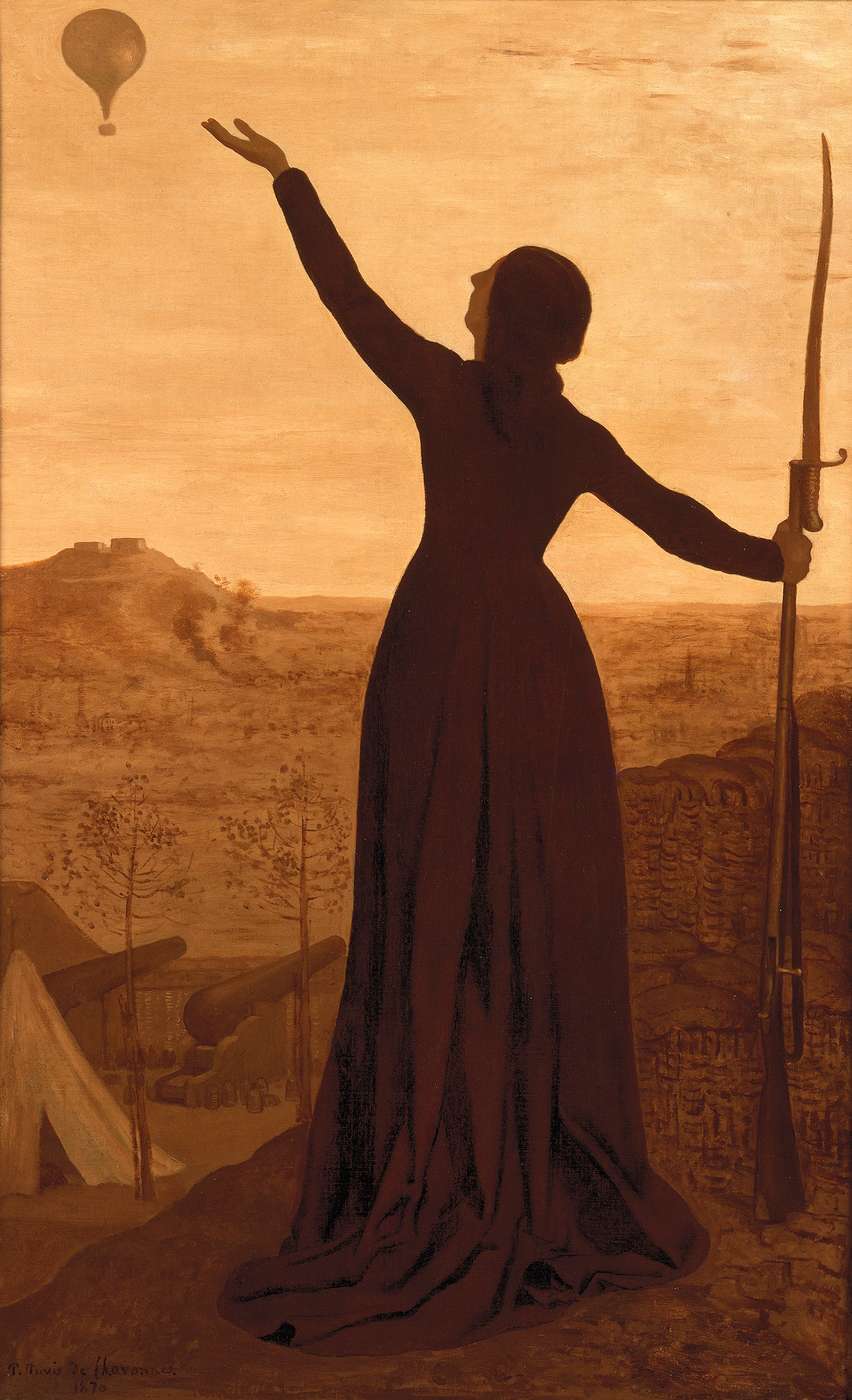
Pierre Puvis de Chavannes, The Balloon (Le Ballon)


Musée d'Orsay, Paris

Date: 1870
Technique: Oil on canvas, 136.7 x 86.5 cm

It was while he was on the ramparts of Paris, when the town was besieged by Prussian troops in 1870, that Puvis had the idea for The Balloon. It was completed by the end of November, and immediately distributed through a lithograph by Emile Vernier, reviewed in the press and admired by the intellectual and artistic elite. They encouraged the artist to produce another to match it. The Pigeon was painted at the beginning of 1871, and again distributed through a lithograph by Vernier.

There are several preparatory drawings and painted sketches (Paris, Musée Carnavalet). But the large paintings are in tones of brown, a fitting colour for the sombre events from which the iconography was drawn. Puvis knew how to avoid the picturesque and dramatic anecdote, so common at the time, and achieve a moving symbol. The paintings echo each other point by point. In The Balloon, a woman with a musket, dressed simply in a severe black dress, turns towards Mount Valérien and waves towards the balloon bearing the news. In The Pigeon, the same figure in mourning, this time portrayed frontally, collects the carrier pigeon which has escaped the talons of the hawks sent by the enemy. In the distance, the Île de la Cité is buried under the heavy snowfalls of that hard winter.

In 1873-1874, Puvis donated the two paintings to the French government for a lottery in New York organised in aid of victims of a great fire which destroyed Chicago in 1871. But he was very attached to these paintings and subsequently regretted handing them over. During his private exhibition at the Durand-Ruel Gallery in 1887, he even displayed photographs of them to compensate for their absence.

Source 1

Source 2

Pierre Puvis de Chavannes, The Pigeon (Le Pigeon)


Musée d'Orsay, Paris

Date: 1871
Technique: Oil on canvas, 136.7 x 86.5 cm

Source 1

Source 2